
Quantitative effects of Leda clay on High-speed Rail

It is past time to put some numbers to the problem of building an HSR line over clay. In summary, Leda clay is a very poor medium on which to build HSR tracks, with damaging vibrations induced at speeds as low as 172 km/h (48 m/s), although with significant engineering effort, by strengthening the soil to a depth of around 4 metres under the entire railway, the low-frequency vibrations can be sufficiently reduced to the point where at speeds of 270 km/h to 300 km/h, track degradation and sonic shockwaves become nuisances rather than severe physical constraints on operating the railway.

Regardless, deep deposits of Leda clay should be avoided in HSR construction where possible, in particular between Ottawa and Hawkesbury, where alignments north of the Ottawa River may be preferred.

Engineering properties

To calculate the displacement and strain in soil under the railroad, I’m using the stiffness matrix method by Eduardo Kausel. This provides an analytic solution for soil that is uniform in the horizontal and layered in the vertical under the assumptions of linear soil response. That linearity assumption means the calculation is only valid while the strain remains small and the soil undamaged. Measurements by Abdellaziz et al. show this to be true for strains up to between 0.01% and 0.015%.

While sound in a homogeneous medium will travel at a mostly uniform speed of sound, in layered media, some of the wavefronts can pass through neighbouring layers at a different speed, creating a strong dependency on the sound speed with the frequency of the wave. The stiffness matrix calculates the pressure at a layer boundary when given an applied displacement as a function of frequency and wavelength. To get the sound speed in the layered systems, one finds the ratio of the wavelength vs. frequency at which the displacement blows up for an applied pressure; this is the inverse of the stiffness matrix, called the flexibility matrix. Kausel defines a critical speed whenever the sound speed reaches a local minimum as a function of frequency1.

To construct these matrices, the elastic parameters of the soil are then needed, preferably in the parameterization of primary and secondary speeds of sound, density, and damping coefficients.

For many soils, and in particular clay, these elastic parameters change with the overburden pressure, and thus depth, of the soil layer. I will adopt two sets of parameters. The first, for St-Étienne-de-Beauharnois clay from Abdellaziz et al. (2021) as they seem somewhat representative of clays found through most of the basin. A profile of somewhat weaker clay was found at the South Gloucester site near Ottawa.

Table of soil parameters at Beauharnois
LayerDepth from original soil surface (m)Layer density (kg/m³)Secondary/shear speed of sound (m/s)Primary/compressive speed of sound (m/s)
Ballast and sub-ballast-0.2–0.41100197300
Dewatered clay crust0.4–11850100163
Beauharnois clay1–61620751500
6–81640791500
8–91690831500
9–101750891500
10–121800951500
12–1418501001500
14–1819001041500
>1819401101500

Notes:

Table of soil parameters at South Glouscester
LayerDepth from original soil surface (m)Layer density (kg/m³)Secondary/shear speed of sound (m/s)Primary/compressive speed of sound (m/s)
Ballast and sub-ballast-0.2–0.41100197300
Dewatered clay crust0.4–11400120200
South Gloucester clay1–31670751500
3–51570601500
5–81700791500
8–101550791500
10–121550951500
12–1515801201500
15–1817101351500
>1820001701500

Critical speed over thick clay

On top of these soil layers, layers with stiffness and moduli equivalent to steel rail and under-rail pads may be added. For UIC 60 profile rail, this gives an equivalent steel plate thickness of 5.95 cm.2 The under-rail pads are assumed to provide 50 MN/m of stiffness at every 0.67 metres along the rail.

As a function of frequency, zeros of the real value of the stiffness matrix were calculated for the soil conditions at Beauharnois with UIC60 rail overlaid.
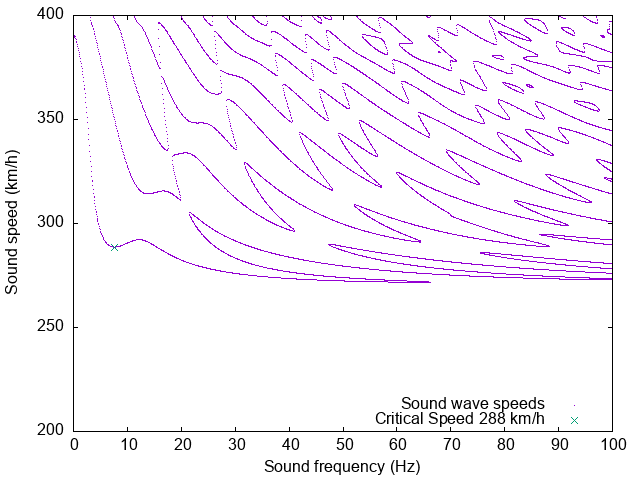
This plot provides the surface wave sound speed for all the modes in the simulated soil, including those that are significantly damped. The strongest mode is the one generated by the first minimum, around 288 km/h, Kausel’s critical speed for this simulated soil. At higher frequencies, some weaker modes propagate in the slowest layer of the soil, in this case at 75 m/s or 270 km/h.

When looking at the soil at Gloucester with UIC60 rail,
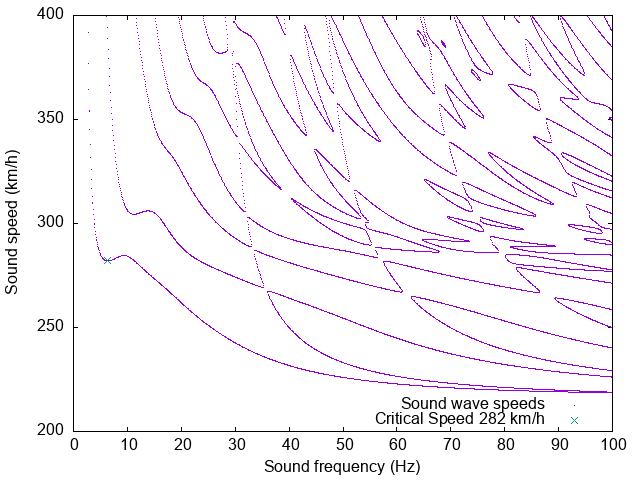
the critical speed is slightly less than that for the soil at Beauharnois, but the effect of the slowest layer in the soil (at 60 m/s or 216 km/h), at 3 to 5 metres in depth, is noticeable at higher sound propagation frequencies.

The full effect is that one should expect the ground, and thus the track, to shake and distort as one approaches these critical speeds of around 280 km/h assuming the soil behaves linearly as in these models.

Displacement of the railbed

To understand the displacement of the rail under a train, the soil stiffness matrix must be multiplied by the source of vibration from the train’s moving weight applied to the rail. For this, a solution in one dimension with repeating boundary conditions was implemented. The source was an infinitely long HSR train with bogies alternately spaced every 17.4 metres and 8.4 metres apart and 2.5 metres between the axles on each bogie, and a 15-tonne axle load per bogie. This is close to the loading one would see from a Siemens Velaro trainset. The weight of the train is assumed to be spread over the 2.59 metre width of a typical rail tie. Finally, the displacement and strains are measured in just the x and z directions. At shallow depths under the rail, the acceleration and displacement calculated should be a slight overestimate of the actual acceleration and displacement.
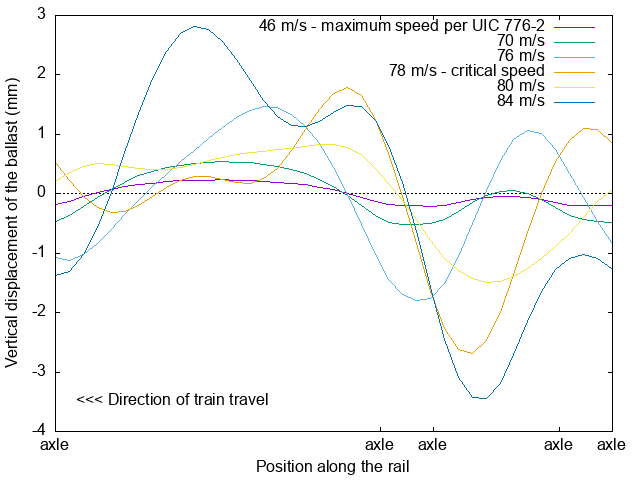
For the South Gloucester soil model, the vertical displacement of the ballast under the train is shown above. When approaching the critical velocity, a sharp shock just ahead of the axles forms. From these displacements, the acceleration of the base of the ballast can be calculated, where the UIC 776-2 limit of 0.35 m/s² for this acceleration is reached at a speed of only 48 m/s or 172 km/h. Above this speed, with a safety margin, the ballast will shake sufficiently so as to reduce its hold on the track structure.

Shear in the subsoil

The stiffness matrix method relies on the soil having a linear response under load.iI.e., the soil is assumed not to weaken. For Leda clay, this is a reasonable assumption until shear strains exceed about 0.000,15. Above that level, the bonds in the clay start to break, and the speed of sound in the soil is reduced.
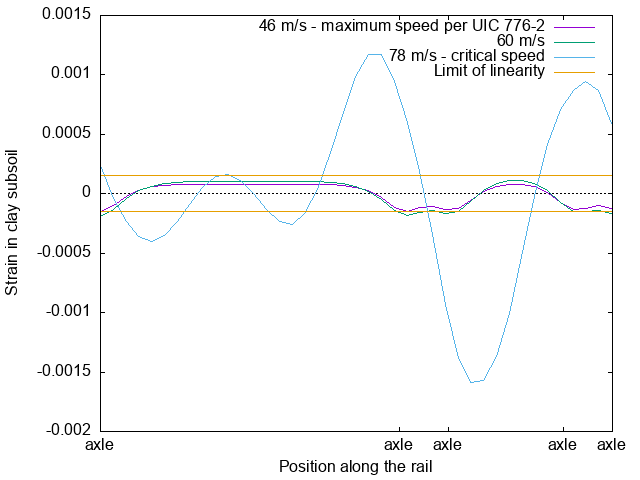
Even at low speed on a ballasted track, and assuming a dry clay crust in the first metre of soil, this linearity limit is nearly exceeded. With higher speed operation, the limit is exceeded, and the critical speed can be assumed to reduce. Upon approaching the critical speed, the soil would start liquifying the soil under the passage of a train, not necessarily at the 78 m/s calculated above.

Leda clay in the presence of strengthened soil layers

Since running HSR on thick layers of Leda clay is problematic, what if there is only a thin layer of clay over shallow bedrock?

This strengthening could occur at depth in the soil. For instance, if HSR is running over a shallow bed of clay, say 1 metre of clay crust over 1 metre of soft clay laying over bedrock, the overall stiffness of the soil and the critical speed increase. However, this increase is relatively modest. For the Beauharnois soil model, the UIC 776-2 vibration limits and soil linearity limits are reached at the following speeds, only just exceeding 200 km/h for shallow 2m clay deposits.

Bedrock depth (m)Limiting speed due to vibration (m/s)Limiting speed to maintain shear < 1.5e-4 (m/s)
26296
36082
45470
55264
65262
85056
104854
infinite4854

Stiffening the soil layers on top of clay deposits is somewhat more promising. These allow the load of a train to be spread over a significantly larger surface of the weak clay.

One simple expedient is to use track supported on a concrete slab. Using the model of Ruiz et al. for the stiffness and thickness of a slab supported track over thick Beauharnois clay, the critical speed is increased to 331 km/h, vibration can be kept below 0.35 m/s² at 60 m/s (216 km/h), and excessive soil shear avoided up to 80 m/s (288 km/h). On this type of track, given no need to maintain ballast stability, the vibration limits might also be relaxed assuming the slab is sufficiently resilient. Keeping acceleration below 1 m/s², a speed of 78 m/s (280 km/h) may be possible, albeit with potentially disruptive sound shocks being transmitted to neighbouring properties.

Strengthening of the soil by introducing cement can also help. Assuming ballasted track over clay strengthened by addition of cement to a shear modulus of 100 MPa, strengthening the soil to a depth of 2 metres increases the speed at which vibration exceeds 0.35 m/s² up to 64 m/s (230 km/h) and the soil shear limit isn’t exceeded until 90 m/s (324 km/h). With 3 metres of strengthened clay, the vibration limit is at 74 m/s (274 km/h) and with 4 metres of strengthened clay, the limit is reached at 86 m/s (310 km/h). At 4m and greater depths, the speed limit is likely underestimated given the 1-dimensional loading model being used.

A reminder of two caveats. Firstly, in these models, the shear strength of the soil needs to be improved to spread the live load. Simply transferring the load to lower strata with piling is insufficient, especially as Leda clay provides very poor anchoring to piles. Secondly, this calculation provides limits to ensure the track remains acceptably undamaged. Acoustic shocks may still propagate through soil layers with low speeds of sound, especially if they encounter structures such as foundations coupled directly to that soil layer.

In certain areas, in particular near Trois-Rivières, there are strata of sand or other firm soils overlaying clay deposits. The shear dynamics of sand are somewhat complicated, but sufficiently thick layers provide support similar to or exceeding that of cement strengthened soil analyzed above. Thus, sand layers of 4 metres of depth or more should be able to support HSR trains at 300 km/h over thick beds of clay without causing track damaging vibrations. Sand is also a better attenuator of high-frequency sound waves that would still generate acoustic shocks in any clay at depths less than 10 m.

Outcome and caveats (updated)

It’s useful to go back to the map generated two posts previous to this one, now with the Prescott and Russell trail added, to see where the speed of high-speed rail would have to interact with clay deposits.

Note that the green areas shown on this map indicate that the clay is at a deep layer in the soil, and the higher layers in the soil are sufficiently stiff as to be suitable for rail construction.

In approaching Ottawa from the east, laying rail on clay will be unavoidable, but the extent to which rail is laid on sensitive clay may be minimized. In particular, rail alignments that either follow the sand island through the Larose Forest, Lemieux and out to Saint-Bernardin, or that cross the Ottawa river either near Orleans or near Thurso and follow the A-50 corridor, may permit 300 km/h operation in closer proximity to Ottawa than other alignments could.

On the Montréal-Quebec segment, this analysis also suggests that certain corridors should be preferably be avoided. In particular, the A-40 alignment just east of Trois-Rivières, which runs over clay where the existing rail corridor largely avoids the worst of it, and between Terrebonne and l’Assomption, where poor soil is likely unavoidable with construction over either clay or bog.

It has been suggested that the flat terrain between Ottawa and Montréal make this the easiest segment of ALTO’s high-speed rail project to construct. When accounting for the need for high-speed on sensitive soils, this assumption doesn’t hold.

The code used to generate the data for this post are available at https://github.com/fbfree/Leda_critv.

  1. In signal analysis, the poles of the matrix, the zeros of the determinant in the complex number plane, would be used to define a critical point. However, Kausel’s definition is useful for finding the lowest real sound speed in proximity to a critical point. ↩︎
  2. The stiffness of a pair of rails in 2-dimensions vertically along its length is given as the moment of inertia of the rail, which can be converted to an equivalent box section with a width of one’s choice. This box section needs to be converted to the equivalent depth of a semi-infinite layer for use with the stiffness matrix method. Here, the assumption is taken that the load from the rail typically applied across a width of 2.59 metres, the standard length of a rail tie. Thus the layer thickness is taken as that of box section of steel with 2.59 metres of width and the equivalent stiffness of the modelled rail. This method is likely to underestimate the peak pressure on soil under a train, depending on the stiffness of the ties in use. ↩︎
Posted in High-speed rail | Leave a comment

Qualitative effects of clay on high-speed rail

This post is the second in a series delving into limitations that Leda clay may impose on HSR. In the last post, we introduced this material and the problem of acoustic shocks generated in the ground. In this post, we’ll look at how these shocks can damage the rail and nearby structures, and interfere with neigbouring land uses. In subsequent posts, I’ll post semi-quantitative calculations of the relevant rail speeds at which these effects become important, and overlay the map from the first post with the maximum attainable rail speed prior to soil improvement.

To start, I’ll apologize for some of the alarmism from the first post. However, the point stands that Leda clay is absolutely prone to subsoil failure. This doesn’t mean that sinkholes will suddenly form under the tracks, at least not in flat terrain.

One effect of soil failure would be settling at an enhanced rate. There are two principal mechanisms for settling in clay. One occurs somewhat slowly in areas where clay is present 8 to 15 m below the soil surface, which is from water being wrung out of the clay under increased pressure. This will occur under embankments, and especially under foundations for heavy overpasses, where an ultimate settling depth of a few percent of the height of the embankment can be expected. This is of lesser concern for a railroad on a shallow embankment, where any slow change in track elevation can be fixed by routine tamping.

The other type of settling comes from failure of shallow soil under shear loads, up to a depth of about 5 m, either from uneven ground pressure, but particularly due to vibrations from passing trains. This type of failure can occur relatively quickly, liquifying the underlying sensitive clay1, and causing the rail embankment to sink into the equivalent of a water bed. This settling can also affect foundations for near-rail structures, overhead catenary in particular.

Other than settling, vibration can also cause the rail structure to degrade. If the ballast that holds the rails in place is strongly shaken, with acceleration exceeding 0.7 times gravity, it can flow, or at even lower accelerations, it can chip and lose it’s ability to hold the rail in place (reference). The liquified clay under the rail can also migrate upwards through other soil layers, commonly seen as ballast contamination and mud pumping.

Finally, vibration that propagates from the rail can affect neighbours. For trains travelling at slow speed, this vibration disipates quickly as one moves away from the rail line. However, at either the Raleigh wave speed, or at a critical speed for soliton propagation2, these waves can be focused into a single wave-front, whence the can propagate far from the railway.

Either through ballast degradation, subsoil failure, or impact outside of the railway, a speed limit of about 190 km/h for trains over these clay deposits is going to be needed. In the next post, I’ll go over some representative locations and calculations of the strain, surface acceleration, and vibration propagation to show how this limit can be defined.

  1. Sensitivity is the ratio of the shear strength of the clay when undisturbed versus after it’s been deformed or ‘remoulded’. ↩︎
  2. A soliton occurs when non-linear effects cause the wave speed for different wavelengths to converge to the same value. In Leda clay, this can occur when the dispersion relation that allows wave speed to increase with frequency and the speed of a wave is to be degraded as a function of strain. Thus, a short sharp wave pulse can catch up to a slower longer wave pulse, locally surpass a shear strain of about 1.5 parts in 10,000, and form something similar to an ocean breaker battering at the neighbour’s foundations. ↩︎
Posted in High-speed rail | Leave a comment

No supersonic trains for Ottawa to Montreal high-speed rail

UPDATE: A bug fix has corrected the quadrupled the clay depth shown in the map at the end of this post.

For Central Canada’s high-speed rail project, the Montreal to Ottawa segment seems like one of the simplest to design. Multiple existing and historic right-of-ways exist over relatively flat and rural terrain, and it seems to be simply an issue of reusing as much existing infrastructure as reasonable to keeps costs low, limiting the number of new grade separations required, and easing track geometries where the benefits exceed the costs to achieve a maximum speed of around 300 km/h. The most complicated part would be in determining how to address the needs of Canadian Pacific Kansas City freight when and where choosing to displace the company from it’s right-of-way.

There is however a complex set of hidden dangers.

Slide Risk

Growing up in British Columbia, the stories of toil and disaster that characterized the building of the railways through the Fraser Canyon, or the unstable shale roadbed of the Kettle Valley Railroad along the steep slopes of the Coquihalla River brought to mind rough terrain. Not the arrow-straight flats of the Ottawa area.

https://www.google.com/maps/embed?pb=!4v1748398543614!6m8!1m7!1s5_xBcSFqPx1bIvSrEngrrQ!2m2!1d45.31798679533181!2d-75.12173257159007!3f269.82462408461055!4f0.4656130588953431!5f2.8086994482653562

That’s before I learned about Ottawa and Quebec’s particularly unforgiving local sediment deposit, Leda clay. This is a mix of the ancient silt deposited at the bottom of the Champlain Sea, held together by salt. Once the salt leaches away and the clay is disturbed, it turns to liquid. Large parts of Ottawa and the Saint-Lawrence Valley are built on top of this, and it has wiped out entire villages.

In considering the arrow-straight rail line from the Streetview above, it directly abuts, but isn’t contained in, a known landslide risk area along the Nation River west of Casselman. Given that the line is still 350 m from the river’s edge and much heavier trains than will operate for HSR have operated along this line for a century without causing slides, it seems that this shouldn’t be a problem. However, there is a related problem.

Weak subsurface

Marine clay makes for a poor foundation material. It is expansive, variably hard or soft, brittle, and fatigue prone. The embankments or foundations for rail beds or structures such as overpasses should be expected to settle significantly in soft clay. The brittleness and fatiguing mean that setting can happen unevenly or after many years of service. The clay can also shift in response to changes in ground water, which can be instigated by fractures generated from ground settling.

There are ways to engineer around some of the failings of clay, either by reducing loading with raft foundations or light-weight fill materials, avoiding placing the railway on structures, mixing stabilizers, i.e. concrete, into the soil to make it more firm, or building deep foundations. Highway and rail engineers have learned to deal with this clay, but HSR brings an additional complication.

Supersonic trains

While the speed of sound in air is upwards of 1200 km/h, depending on altitude and humidity, and sound travels even faster longitudinally in dense materials, shear waves can be slower.

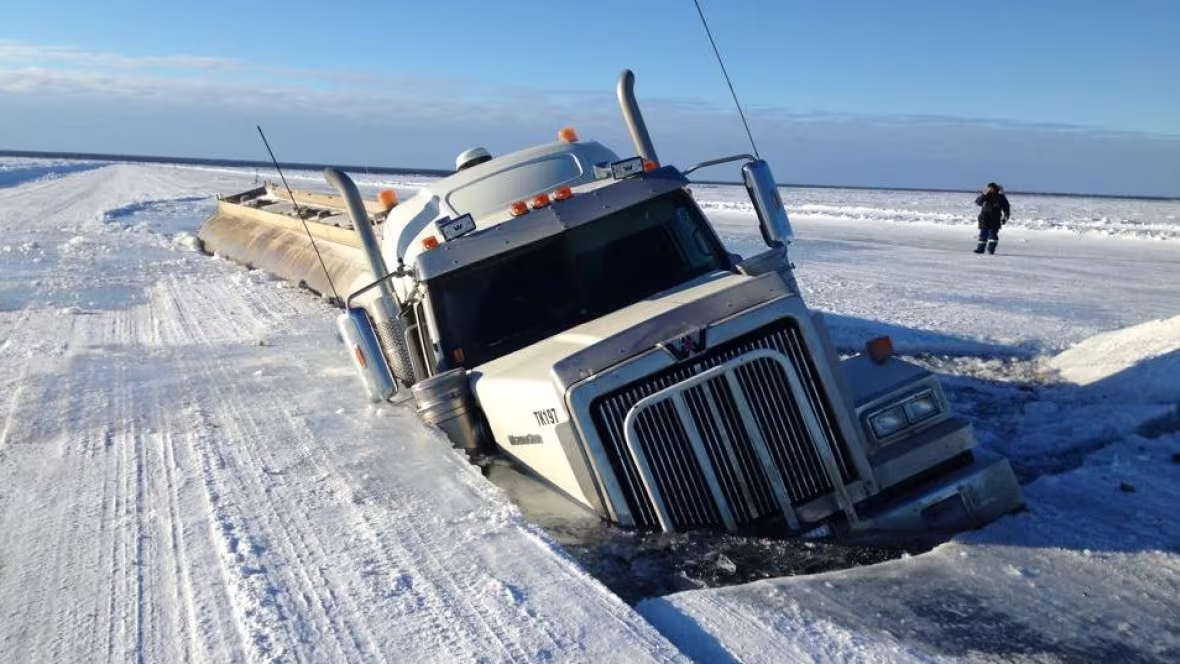
This will be familiar to anyone who knows about speed limits on ice roads. If a truck on an ice road approaches the speed of sound for the shear waves, or the system’s critical speed which can be as low as 20 km/h, it can create amplified shock waves that can buckle the surface, with frightening consequences.

In undisturbed Leda clay, this critical speed depends largely on the sound speed, which has been measured near 270 km/h1, such that HSR trains could be expected to produce shock waves. Shallower soft clay deposits may have even lower critical speeds.

There’s a well studied example of these sonic booms affecting a 200m long stretch of railway on a mix of marine clay and organic subsoils in Sweden near Ledsgard, where train speed was designed for 180 km/h. The resulting sonic booms affected both the infrastructure and neighbours. Such shocks could also progressively degrade clay under the railbed, lowering the critical speed and/or damaging nearby structures or banks. Best design practice is still debated, but where linear response of the subsoil can be assumed, a design speed of around 70% of the critical speed is often acceptable. Thus, any HSR line over untreated deposits of Leda clay would be limited to around 190 km/h maximum or less, regardless of track curvature.

While the critical speed in Leda clay may be higher than that found at Ledsgard, Leda clay has less damping than other soft soils. This both allows for more confidence in the linearity of the soil’s dynamics, but also that any vibrations generated will tend to travel farther from the railway, increasing impacts on nearby structures and users.

Extent of clay

Given the multitude of problems with Leda clay, a right-of-way that avoids thick near-surface deposits of clay vastly simplify HSR construction.

Unfortunately, such deposits are largely unavoidable in either the Vaudreuil-Soulanges areas west of Montréal, or the eastern approaches to Ottawa.

Looking at this map, I no longer wonder why Highway 417 deviates so far south from the Ottawa River.

In a later post, I hope to examine some of the consequences of these clay deposits on the design of Central Canada’s high-speed rail.

  1. At pressures reached at depths below about 10 m, water is force out of the clay, and the critical speed increases slightly, to around 360 km/h. ↩︎

Posted in High-speed rail | Leave a comment

The Cheap Way to Improve Reliability of the New York Subway

First, apologies for the crayon, but I hope to make a point.

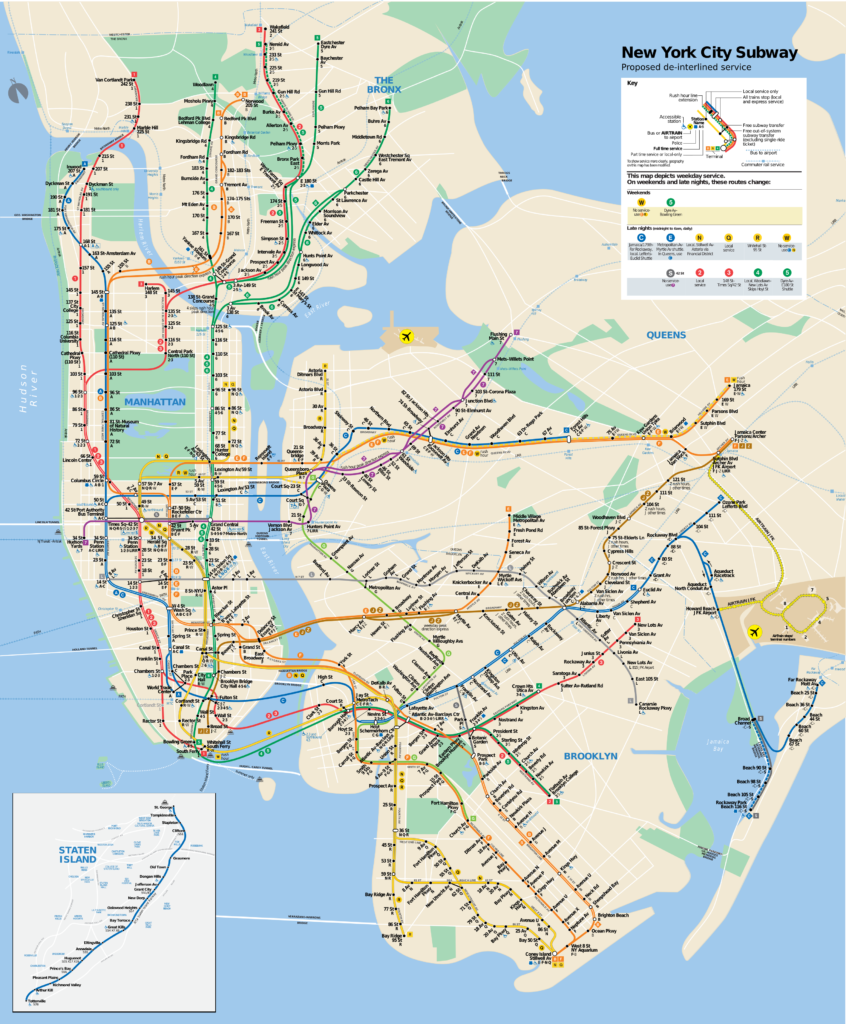
Several recent power outages have each led to a nearly complete loss of service to the B-division of the New York City Subway. Even on a day-to-day basis, the subway is scourged by inconsistent service and crowded trains. The MTA is using this recent publicity to push for upgrading the subway’s signal infrastructure, making that very expensive and long-term solution seem like the way forward. While signal upgrades have merit, there is a much simpler way to avoid propagated delays in the subway: de-interlining, or as Alon Levy puts it, eliminating reverse branching. If the B, D, and E never crossed paths with other subway lines, the power outage at 7th Ave/53rd would have never affected the entire subway network. In addition to preventing system meltdowns, Alon’s posts point out that de-interlining allows for simpler scheduling, easier wayfinding, more frequent trains, reduced wear on switches, and reduced bunching of trains.

Such a de-interlined service could look like:


Continue reading

Posted in Transit | Leave a comment

Bus Tracker Data – Automated

Bus tracker data and plots for approximately half of the CTA’s routes are now available. For about half of these, plots and data are being automatically posted around 3 am every operating day. I will be working over the next month to expand the number of tracked bus routes, to start tracking the ‘L’, and to make the data easier to navigate.

As the CTA generously provides their Bus Tracker and Train Tracker APIs to developers including myself, I am releasing my derived data files and plots under the condition that they be used only to assist transit customers or to promote public transportation.

Enjoy.

Posted in Bus Tracker Data, Transit | Leave a comment

Detectable Warning Tiles

Detectable warning tiles, the tactile warning bumps at curb ramps, have been ADA mandated in new sidewalk construction since 2001. As per guidance from the Federal Highway Administration, detectable warning fields require good drainage and frequent sweeping in order to prevent the accumulation of water and debris. In Chicago, good drainage is famously difficult and the tiles rapidly deteriorate. Frost heave breaks fasteners and lifts many tiles out the sidewalk, causing tripping hazards, splashing, and an obstacle for those with reduced mobility.

Continue reading

Posted in Walking | 3 Comments

South Lakefront Corridor Transit Study — Shame!

In 2012 the Chicago Department of Transportation commissioned the South Lakefront Corridor Transit Study (“the report”) from 31st to 95th streets in response to very strong community interest in improving transit access, especially along the Metra Electric corridor. The report used dishonest assumptions to pan the idea of rapid transit service on the Metra Electric line, citing high capital and operational costs and low ridership.

This post will focus on Section 5 and Appendix A of the report.

Appendix A

Continue reading

Posted in Transit | 5 Comments

55th Street Streetscape Master Plan

In my previous post, I explored how complete streets priorities are reversed in 55th Street’s existing streetscape. At a meeting Thursday February 5, 2015, CDOT presented a fiscally unconstrained wish list of proposed streetscape improvements for community feedback.


Download

The topics in the comments below roughly follow the order of these slides.

Continue reading

Posted in Automotive, Cycling, Transit, Walking | 1 Comment

South Lakeshore Drive Express Buses

Bus tracker data for four of six Chicago’s south Lake Shore Drive express bus routes, the 2, 6, J14, and 28, were collected in November and early December 2014.

The J14 Jeffery Jump is branded as a premium bus route with features, such as improved bus station design, peak period dedicated lanes, and transit signal priority.  During peak periods, these features allow the J14 delivers reliable service with consistent travel times and limited bus bunching. Travel times on the two miles through the loop are nearly as long as the entire run along Jeffery Boulevard suggesting that the investment in the loop can further significantly improved travel times.

J14 - Jeffery Jump Thursday Nov 13, 2014

Continue reading

Posted in Bus Tracker Data, Transit | 4 Comments

55th Street Streetscape – Existing Conditions

On Thursday, I attended CDOT’s second public meeting for a new 55th Street Streetscape Master Plan in Hyde Park.  In this first of two posts, I’ll examine existing streetscape conditions on 55th street.

Three years ago, 55th Street received a road diet that reduced the barrier the street presents for pedestrians and allowed the installation of protected bicycle lanes. Before this change, 55th Street had not changed significantly since urban renewal when businesses were cleared from the street and it was widened into a fast four lane arterial street.

I feel that a master plan for 55th Street should not focus solely on the streetscape but also on land use. The street’s corridor acts as a barrier between the university and the residences and commercial activity in the northern and eastern parts of the neighbourhood and consumes some of the most valuable land on the South Side. However, land use is outside of the scope of CDOT’s plan and tangential to the scope of this blog. Rather than imagining 55th as a blank slate, let’s analyze a redesign of 55th street that improves safety and convenience for existing street users consistent with Chicago’s Complete Streets priorities.

Continue reading

Posted in Automotive, Cycling, Transit, University of Chicago, Walking | 1 Comment